
A festive message from Professor Dame Anna Dominczak, Chief Scientist (Health), The Scottish Government
Looking back on 2025, a great deal has been achieved, and for that hard work undertaken across our research and innovation community, I am very grateful
Now, we must tap further into the collaborative capabilities at our disposal. Unity is power and the more we reach out to combine diverse skillsets — whether that’s across sectors or nations — the better for Scotland.
Earlier this year, I spoke about the need to bring NHS, academia, and the life sciences industry closer together. That remains a key goal for harnessing optimal innovation.
More than ever, all three components of the triple helix model must come together as one for the benefit of Scottish society — for patient, community, and economy.
I have been proud of many collaborations this year involving clinical research, testing and development of innovation, and adoption.
The Chief Scientist Office (CSO) Innovation Hubs have facilitated collaboration by leveraging the triple helix; CSO Clinical & Public Health Research grants have provided a platform for NHS and university–sponsored clinical trials; and ‘once for Scotland’ adoption has been realised through the Accelerated National Innovation Adoption (ANIA) Pathway and Innovation Design Authority (IDA).
ANIA, funded by the Scottish Government and led by the Centre for Sustainable Delivery, is designed to accelerate proven innovations into frontline healthcare across Scotland, and I am certain that there is much more to come.
Indeed, only last month, it was announced that new funding would be provided for diabetes prevention through fresh digital approaches.
Representing innovation in action and a demonstration of our fast-tracking approach via ANIA, the activity is expected to prevent up to 4,000 people from developing type 2 diabetes.
The investment will offer education hand in hand with virtual, app-based, individual consultations with nutritionists, dieticians and health coaches.
A further recently funded programme has been ambulatory Electrocardiogram (ECG) patch monitors which, once implemented, will prevent almost 700 recurrent strokes over five years.
There is also investment in genetic point of care testing for newborn babies with around one in 500 having a genetic variation that causes profound deafness when treated with the common emergency antibiotic.
These newborns will be given an alternative antibiotic. Starting in Glasgow, this will be rolled out to all Territorial Health Boards within 18 months.
Another test will identify the 28-30% of people with a genetic variant that means they do not benefit from the common drug prescribed to prevent a secondary stroke.
20,000 recent stroke patients will be tested per year and around 6,700 put on a more effective drug. The process of rolling this out to all Territorial Health Boards within 12 months has already begun.
We are also continuing to work closely with colleagues across the UK as part of the Voluntary Scheme for Branded Medicine Pricing, Access and Growth (VPAG) Investment Programme to provide a globally competitive ‘once for Scotland’ delivery network for commercial clinical trials.
Indeed, the Collaborative Accelerator for Commercial Clinical TriAL DeliverY in ScoTland (CATALYST) initiative is boosting Scotland's capacity and infrastructure.
CATALYST has included the establishment of four Commercial Research Delivery Centres (CRDCs) across Scotland, which act as regional hubs for pioneering clinical trials.
Phase 2 will see the development and launch of ‘spokes’ to develop commercial research in primary care, remote and rural communities with flexible teams for local, mobile, and ‘pop-up’ research delivery.
Further collaboration this year saw a CSO and NHS Research Scotland partnership with the Academy of Medical Sciences which has delivered a ‘Scottish Cross-Sector Hub’ including events which centred on specific areas of interest — ‘Engaging with Life Sciences Industry and Entrepreneurship in Scotland’, ‘Precision Medicine and Precision Population Health’, and ‘Data and Digital Health’.
The Scotland Cross-Sector Hub has successfully fostered and enhanced multidisciplinary connections and collaborations, facilitating health and life sciences research and innovation.
With each gathering, we welcomed researchers and innovators from the triple helix and related disciplines. Attendees were encouraged to develop new cross-disciplinary projects to further enhance Scotland’s successes in life sciences and biomedicine.
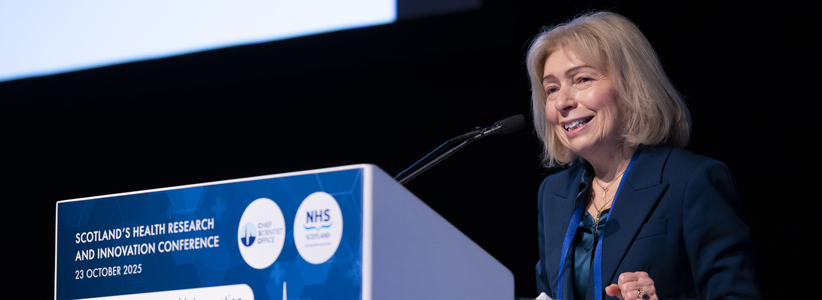
Perhaps a standout this year was Scotland’s Health Research and Innovation Conference, held in October in Edinburgh.
Hosted by CSO and NRS, the theme of the conference, ‘Research Enabled Health Innovation’, reflected our joint ambition to empower an exciting new era of care.
We were proud to have had the opportunity of being joined by some 550 delegates — researchers, innovators, healthcare staff, policymakers, industry, and the public — to share, discuss, and contribute to, that vision.
So many insights were shared and so many exciting ideas highlighted, inspiring all in attendance through plenary, parallel, and poster sessions, while no doubt making fresh connections amid a vibrant exhibition area.
We are truly grateful to all those who attended, interacted, and supported our belief in the power of a unified will to unlock Scotland’s full health research and innovation potential.
With the help of a truly diverse and knowledgeable line-up of speakers, I am delighted to have been part of such a memorable day which I believe has set Scotland firmly on the road to a progressive new health research and innovation agenda with prevention considered a key piece of the puzzle.
Of course, no less important is the sustained focus on ensuring patients and the public are central to driving improvements in healthcare — from shaping research through patient and public involvement in 2026, to continuing support for Our Future Health with more clinics opening across Scotland, and inspiring participation in key initiatives such as SHARE — Scottish Health Research Register and Biobank.
I already have a busy 2026 in store, including a chance to speak in January at the Festival of Genomics and Biodata in London.
I will be joining a panel to discuss ‘Genomics, Strategy, and the Next Decade of UK Life Sciences’, looking at how new national infrastructure, such as community trial sites and new regulatory pathways, can reduce trial timelines and costs.
Looking further ahead, I am energised by what lies in store in 2026 and believe we can achieve great things together, but for now, on behalf of the Chief Scientist Office, I thank you all once again for your industry and commitment and wish you a healthy and happy festive season.
Publication date: 12th December 2025


