Tayside leader in Parkinson’s research announced as winner of prestigious international award
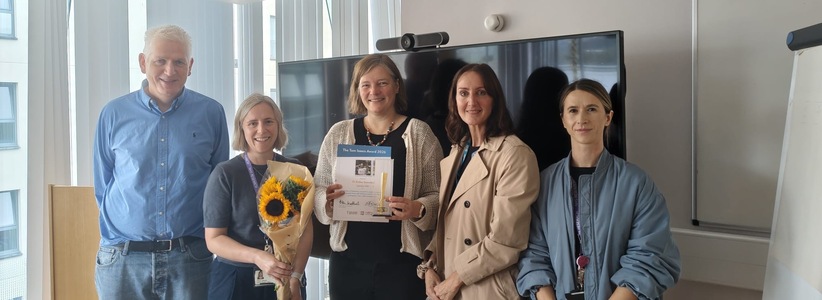
A leading figure in Scottish research into Parkinson’s Disease has received a prestigious international award after being nominated by NHS Research Scotland Neuroprogessive and Dementia Network (NRS NDN) colleagues
Dr Esther Sammler, who works as both a consultant neurologist at NHS Tayside and a researcher at the University of Dundee where she focusses on translating laboratory discoveries into better treatments for Parkinson’s, has been named the winner of the 2026 Tom Isaacs Award.
Jointly presented by Cure Parkinson’s and Van Andel Institute (VAI), the award recognises a researcher who is making a meaningful difference to people affected by Parkinson’s by working collaboratively with the community.
It celebrates “impactful research, genuine collaboration, and a strong commitment to partnership” — and judges concluded that the NRS NDN nomination of Dr Sammler’s “inspirational” contribution to Parkinson’s research was a standout.
Dr Sammler was put forward by Senior Clinical Studies Officer Justine Hudson, Clinical Studies Officer Tiffany Stewart and the wider Tayside NDN team.
Their award submission stated: “Esther’s passion and determination to make a difference to the lives of those affected by Parkinson’s is inspirational in the eyes of her patients, colleagues and across the wider field.
“She does so with such warmth, empathy and an abundance of compassion. She is a phenomenal clinician, scientist, supervisor and mentor who is building a legacy that will last for decades to come.”
Dr Sammler’s win was announced at the annual Grand Challenges in Parkinson’s Disease symposium and parallel Rallying to the Challenge meeting for people living with Parkinson’s, held in Grand Rapids, Michigan.
The award was presented to Dr Sammler virtually by Cure Parkinson’s CEO Helen Matthews and Parkinson’s advocate Jessi Keaveney.
Within her lab at the university’s Medical Research Council Protein Phosphorlylation and Ubiquitylation Unit (MRC-PPU), Dr Sammler leads a team of post-doctoral researchers and PhD students working on projects relating to the gene LRRK2 and its relationship to Parkinson’s.
In her NHS role, alongside being an NHS movement disorder specialist, she also leads a portfolio of phase 2 and phase 3 clinical trials for Parkinson’s. This included leading the successful Abbvie Foslevodopa/Foscarbidopa trial in 2019, later licensed as Produodopa.
Alongside her research, Dr Sammler works extensively with Parkinson’s advocate groups and charities. Recently, Dr Sammler was also part of a collaborative effort to develop a more holistic approach to Parkinson’s care.
The new role is the first of its kind in the UK and recognises the increasing need for mental health support for those living with Parkinson’s which affects around one in every 375 adults living in Scotland. Dr Sammler is also committed to developing the next generation of researchers and clinicians, mentoring staff and encouraging them to challenge themselves.
Helen Matthews, CEO of Cure Parkinson’s, said: “We are delighted to present the Tom Isaacs Award for 2026 to Esther. In both her consultant neurologist and researcher roles she has shown an outstanding commitment to bettering the lives of those affected by Parkinson’s.
“Esther has also shown a real dedication to the Parkinson’s community beyond her day-to-day roles, working with Parkinson’s community and advocacy groups and charities, as well as mentoring junior colleagues. We are truly thrilled to celebrate Esther’s incredible work and commitment to the Parkinson’s community with this award.”
Last year, Dundee’s clinical trials and research team received international recognition after its site became one of the first in the world to launch a phase 3 clinical trial investigating a potential disease-modifying treatment for Parkinson’s disease.
The PARAISO study (BN44715) — led by Dr Sammler — is investigating a monoclonal antibody designed to target abnormal protein clumps in the brain associated with Parkinson’s disease.
She said: “The real driving force behind research is the people who take part — progress towards better treatments simply isn’t possible without them.”
Publication date: 30th September 2026


