' fill='%23ffffff'%3E%3Cpath d='M283.94,167.31l386.39,516.64L281.5,1104h87.51l340.42-367.76L984.48,1104h297.8L874.15,558.3l361.92-390.99 h-87.51l-313.51,338.7l-253.31-338.7H283.94z M412.63,231.77h136.81l604.13,807.76h-136.81L412.63,231.77z'%3E%3C/path%3E%3C/g%3E%3C/svg%3E%0A)

About ENRICH Scotland
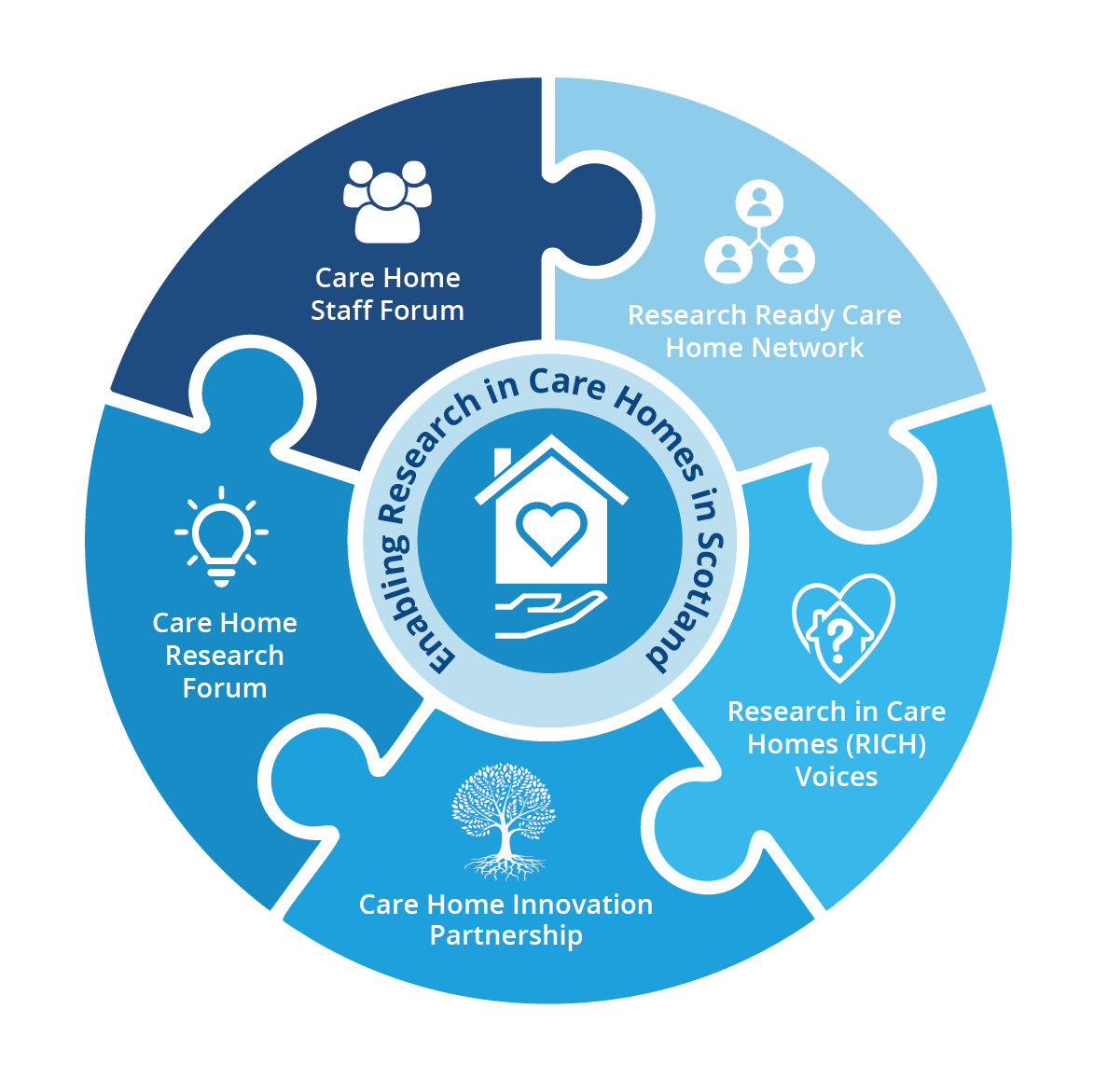
The network brings together care home staff, residents and researchers to facilitate the design and delivery of research, to improve the quality of life, treatments and care for all residents. ENRICH Scotland works closely with NHS Research Scotland's Neuroprogressive and Dementia Network, the Ageing Specialty Group and the Primary Care Network, and is co-chaired by Dr Emma Law and Professor Susan Shenkin.
The Forum works collaboratively with NIHR ENRICH, making this uniquely fit for Scottish care homes, to establish which homes are ready to practice research.
There are now two Care Home Innovation Partnerships (CHIPs) working with ENRICH Scotland. The first CHIP was founded in 2018 in Lothian by Dr Jo Hockley and a group of managers from care homes interested in developing care home-led tests of change. This model has proved so successful, it has now been replicated in Glasgow City, with plans for more across Scotland.
Care Homes involved with the Lothian CHIP include St Raphaels; Cluny Lodge; Manor Grange; Braeburn; Chamberlain and Erskine Edinburgh. The Lothian Care Homes website is a useful and up to date resource for finding out more about the current work.
Care Homes involved with the Glasgow City CHIP include Riverside House; Orchard Grove House; Victoria Gardens Care Home; Hawthorn House; and Meadowburn Care Home.
Contact us if you have questions about any aspect of our work
Studies we support
ENRICH Scotland supports a variety of studies taking place across the countries care home landscape. Details of current studies can be found in the listing below.
What matters to me? Show more Show less
To follow up on some earlier research that she did, Clare Halpenny from Edinburgh University would like to engage with care home residents in Lothian who are over 65 and have moved into the care home within the last 5 years. This is to help understand what is important to people living in care homes about moving. Taking part would involve participation in a craft activity, with no prior experience of crafts needed.
If you are interested, please get in touch with Clare on clare.halpenny@ed.ac.uk.
Dementia knowledge survey Show more Show less
Researchers from the University of Liverpool are examining variations in knowledge and awareness of dementia across Europian countires and demographics. The findings from this study could inform targeted educational inititives, foster greater undersradning of dementia and contribute to the development of policies aimed at improving early detection and more equal access to care. The findings could also help reduce disparities in dementia outcomes and improve the quality of life for people affected by dementia and their families.
Exploring resilience in the dementia social care workforce Show more Show less
This study is looking at exploring resilience in the dementia social care workforce as part of a wider project, specifically how the physical and mental health of dementia social care workers impacts their resilience. The survey can be accessed at 'Exploring resilience in the dementia social care workforce' and takes around 20 mins to complete. Participants can opt in to a prize draw as reimbursement for participation, 1st prize £100, 2nd £50 or 3rd £25 Amazon voucher.
If you have any questions, please contact Jessica Bird on j.bird@liverpool.ac.uk.
WATCH Project: Widening Access to Trials in Care Homes Show more Show less
ENRICH have been working alongside NHS Grampian and Aberdeen and Edinburgh Universities on a research study exploring the inclusion of care home residents in vaccine trials. We have been lucky enough to have had input from care home managers, and are now looking to speak with care home residents and staff about their views and experiences on recruiting care home residents for vaccine trials. The aim of gaining a better understanding of this, is to ensure that the care home population become better represented in care home trials.
Staff and family members from across Scotland can participate, as well as residents in homes in the Grampian area. Discussions can take place via teams/phonecall or for Aberdeen participants, a face to face conversation. Please contact selvarani.subbarayan2@nhs.scot for any further information. She is very happy to answer any questions.
Workshop: Co-designing a conversation guide for care planning with older adults, families and professionals Show more Show less
Lucy Halamova from Aberdeen University would like help to create a useful conversation guide to help older adults and their families be better prepared for making decisions about care. She is holding a workshop at Aberdeen University and on Teams to gain input from care home staff, relatives and older adults. Participants will be given £20 cash or voucher as compensation for their time.
If you think you might be interested, please contact Lucy on l.halamova.23@abdn.ac.uk.
How can Schwartz Rounds be Changed to Meet the Needs of Care Home Staff and be Feasible to Implement in Care Home Settings Show more Show less
Care homes face challenges such as high staff turnover, vacancies, low pay and limited career opportunities. These factors, amongst other things, can lead to poor staff wellbeing. There is limited support available for care home staff wellbeing and significant barriers to staff accessing support. Researchers from the University of Liverpool are looking to speak to care home staff to see how ’Schwartz Rounds' could be adapted to support care home staff wellbeing. Schwartz Rounds are group-based reflective interventions that have positive outcomes in staff wellbeing in healthcare settings.
Participation would involve a 45 minute video call with the researcher. If you are interested, please contact tfkitto@liverpool.ac.uk.
OASIS CARE: Care home support survey for hallucinations in dementia Show more Show less
This is a UK-wide survey to understand the knowledge, confidence and approaches that care home staff have towards supporting people living with dementia who experience hallucinations, in care home settings.
The survey is likely to take 15-30 minutes.
Person-centred Use of Music in residents living with dementia and Associated changes in behaviour in care homes (PUMA) Show more Show less
This is an opportunity to take part in a UK wide study exploring whether including personalised music within individual care plans can improve wellbeing, support quality care, and reduce changed behaviours, such as distress, for people living with dementia.
Half of the care homes taking part will receive training to support the of use personalised music within care planning, and the other half will continue with usual care — both groups are vital for comparing outcomes and will be randomly allocated. If you are interested in participating or would like more information, please contact puma@sheffield.ac.uko or get in touch with the ENRICH team on tay.enrichscotland@nhs.scot.
AMPER Study (NHS Greater Glasgow and Clyde only) Show more Show less
This study invites people with Alzheimer’s disease and their carers or family members to take part in a 12-week trial of “AMPER,” a digital tool designed to support reminiscing through prompts and memorabilia like photos and audio recordings. The aim is to explore whether AMPER can improve well-being, identity, and self-worth by encouraging meaningful conversations. Participation is voluntary, and both patients and carers can withdraw at any time without affecting care. Sessions will take place either at the University of Strathclyde or in the participant’s home, depending on space.
Those interested please contact Professor Mario Parra at mario.parra-rodriguez@strath.ac.uk or call 07872 417411.


